Irvine Ranch Natural Landmarks are home to hundreds of species of plants and animals, including over 15 raptor species that can be found nesting in trees, cliffs, and even on the ground. Annually Raptor nesting season can begin as early as fall and continue through late summer. With the spring season underway, Irvine Ranch Conservancy staff in collaboration with internationally acclaimed Raptor biologist, Peter H. Bloom are locating raptor nests on the Landmarks for monitoring and to document egg laying, incubation, hatching and fledging.
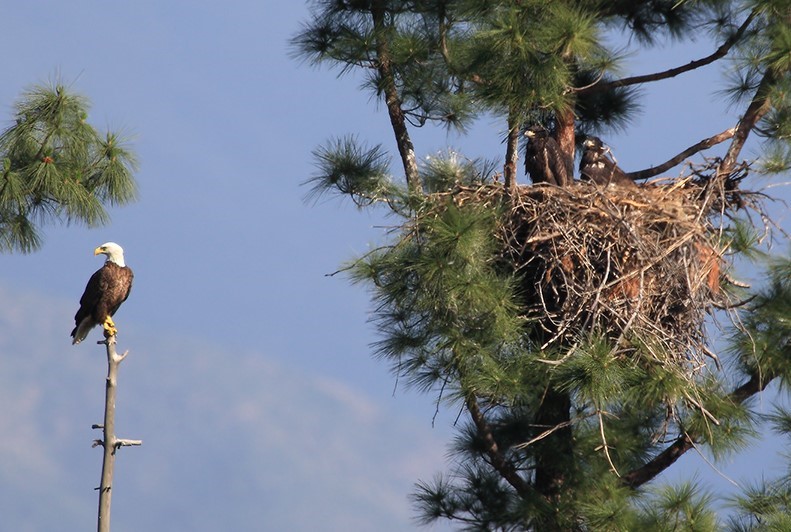
Many of the raptors seen throughout the developed parts of Orange County were likely born and raised on the Irvine Ranch Natural Landmarks. The most abundant raptor species observed on the Landmarks is the Red-Tailed Hawk, nesting mostly in willows, oaks, eucalyptus, sycamores, cliffs, and power towers. Other regular breeders and nesters on the Landmarks include the Red-Shouldered Hawk, Cooper’s Hawk, Barn Owl, Bald Eagle, White-tailed Kite, Golden Eagle, and many others.
Each year, the Conservancy works in collaboration with OC Parks, the City of Irvine, and the City of Newport Beach to prevent birds from being alarmed by human activity on the trails while they are incubating eggs or caring for young. Conservancy staff along with biologist, Peter H. Bloom and Bloom Biological Inc. work together to locate the nests, assign each nest an ID number, and then assign those ID numbers to trained volunteers for monitoring on the land every few weeks throughout the season.
Raptor monitoring volunteers attend a training session to learn professional monitoring practices to avoid flushing birds from their nests or disturbing them in any way. Maintaining a safe distance is the most important factor, but other monitoring protocol includes minimizing the time spent at the nest and leaving or stepping away if you flush a raptor from the nest or disturb the adults or chicks in any way. Volunteers are asked to avoid attracting the attention of others to the nest location. If a new nest is observed, it is important that the volunteer stay a minimum of 75 feet away from the nest and informs the Conservancy program coordinator about the discovery. Communication with the program coordinator throughout the monitoring process is imperative, as sometimes activities and programs may need to be canceled or altered to not disturb a nest.
Once volunteers are trained and have received an assigned nest, they begin the monitoring visits and conduct surveys by foot using binoculars or spotting scopes. The volunteers complete a form during each visit, noting their name, date, nest ID, visitation number, time spent observing the nest, the raptor species, rearing behavior, number of chicks, and any additional notes that are helpful for the Conservancy staff to document.
At the end of the nesting season, the survey will provide insights into the nest’s success, survival rates from one stage to the next, and fledging numbers and factors. Each species will have unique results and interesting facts will be learned from each volunteer. Raptor monitoring is a volunteer-driven program and because of the time and dedication from these volunteers, raptors are more likely to survive and thrive on the Landmarks and the Conservancy is able to maintain an environment that sustains humans and wild animals alike.
“We truly believe we get more than we give as volunteers with the Conservancy,” said Donna and Doug Bell, Irvine Ranch Conservancy volunteers since 2008. “We started out participating in public hikes and stewardship programs and as our love for the outdoors grew, we began to feel a sense of ownership and became volunteers. Raptor monitoring is an amazing experience that really opens your eyes to the importance of protecting the lands.”
You do not need to be a volunteer to experience raptors on the landmarks. Outdoor enthusiasts can start with participating in an interpretive program such as Shh.. Hike, Look & Listen from 5-7 p.m. on April 18 at Black Star Canyon Wilderness Park and watch for soaring red-tailed hawks, listen to birds quietly sing, and inhale the fragrance of fresh sage. Another interpretive program available for bird enthusiasts is Better Birding Basics: Birds of Bommer Canyon from 8-11 a.m. on April 26 at Bommer Canyon. This easy walking trail passes through a sycamore grove and along riparian, coastal sage scrub, and grassland habitats that attract birds such as hawks, owls, kites, woodpeckers, quail, meadowlarks and many others. You can make any hike a birding hike if you have binoculars handy!
Irvine Ranch Conservancy offers a full calendar of spring activities highlighting local native and seasonal resident birds on the Landmarks. Guided programs include hiking, mountain bike rides, horseback riding, habitat restoration and special events for nature enthusiasts of all ages and fitness skill levels. All activities are free with required pre-registration, which closes at 4 p.m. the day prior to each event. For more details visit LetsGoOutside.org/activities.
####
Irvine Ranch Conservancy is a non-profit, non-advocacy organization created in 2005 to help preserve and support the Irvine Ranch Natural Landmarks, enhancing the public’s connection to the land while helping partners and landowners with all aspects of stewardship. The Conservancy offers a variety of free, guided outdoor programs for all nature enthusiasts including hiking, mountain biking, horse-back riding and much more. For more information, visit www.letsgooutside.org.
Christine Graves
PR & Event Marketing Specialist