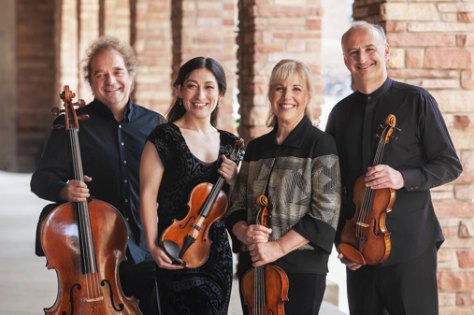
The Takács Quartet returns to Segerstrom Center for the Arts on February 28, 2019, at 8:00 pm. The ensemble, considered to be one of the world’s greatest string quartets, welcomed second violinist Harumi Rhodes earlier this year following the retirement of founding member Kàroly Schranz. Quartet members include Edward Dusinberre and Harumi Rhodes, violins; Geraldine Walther, viola; and Andràs Fejér, cello.
Single tickets start at $39 and are now available online at www.SCFTA.org, at the Box Office at 600 Town Center Drive in Costa Mesa or by calling (714) 556-2787. For inquiries about group ticket savings of 10 or more, please call the Group Services office at (714) 755-0236.
Segerstrom Center for the Arts applauds the Colburn Foundation for its support of the Chamber Music Series and its corporate partners including Kia Motors America, Official Automotive Partner; United Airlines, Official Airline; and Omaha Steaks International, Official Fine Food Retailer.
PROGRAM NOTES
Haydn: Quartet Op. 76, No. 1
Franz Joseph Haydn (1732-1809) received the commission for the quartet from the Count Joseph Erdödy who asked Haydn for a set of quartets, which he began composing in 1796 and officially published in 1799. The quartet opens with a sprightly tune, played individually by each instrument at the start, then developed rather guilelessly for the remainder of the movement. The second movement is a thoughtful, beautiful aria, with an underlying heart-throb rhythm underlying much of the section. A faster tempo and a lighter character identify the third movement, with a trio that has roots in Austrian Ländler dance. Not light and fluffy like earlier Haydn finales, the last movement brings necessary weight and importance to balance what came before. Although the quartet is in G major, Haydn starts the last movement in a unison G minor. Only at the very end of this stormy finale does the moody minor mode abruptly shift to the key signature as Haydn pulls back from ending on a somber note.
Bartók: String Quartet No. 6
Deeply impacted by the loss of his mother and the outbreak of World War II, Béla Bartók (1881-1945) finished his beautifully moving, albeit extremely somber sixth string quartet in 1939. Each movement is preceded by an introductory section marked “Mesto” (sadly), reappearing in different settings at the beginnings of the second and third movements, and serving as the principal subject of the finale. Full of sudden tempo shifts and ingenious treatment of thematic motifs, the first movement closes with the first violin’s high A shimmering quietly all alone. The second movement lurches along with dotted rhythms and unexpected accents, followed by the Burletta (or Burlesque) third movement which brings a hint of irony and sarcasm. The fourth movement opens again with the Mesto theme introduced by the first violin but subsequently shared by all. Bartók constructs the ensuing finale entirely from that bleak melody. This is briefly relieved by themes reminiscent of the first movement, but the Mesto music reasserts itself before bringing the work to a close.
Grieg: String Quartet
Edvard Grieg (1843-1907) did not often work in the large-scale sonata form; his entire completed literature in this form consists of a symphony that he suppressed, one concerto, one cello sonata, three violin sonatas, and this quartet. Composed in 1877-1878, the String Quartet is an exceedingly attractive and untroubled work, with a melodic spirit that recalls his best songs or piano works. One song-like figure, in particular, is used throughout. Grieg does treat his material in sonata fashion, but not rigorously. There is a feeling of Norwegian peasant dances in the scherzo, while the finale trots merrily with a saltarello rhythm. It is, in short, a lovable work, heartwarming in the way that Grieg’s music so often is.
BIOGRAPHICAL INFORMATION
The Takács Quartet, now entering its forty-fourth season, is renowned for the vitality of its interpretations. The New York Times recently lauded the ensemble for “revealing the familiar as unfamiliar, making the most traditional of works feel radical once more”, and the Financial Times described a recent concert at the Wigmore Hall: “Even in the most fiendish repertoire these players show no fear, injecting the music with a heady sense of freedom. At the same time, though, there is uncompromising attention to detail: neither a note nor a bow-hair is out of place.”
Based in Boulder at the University of Colorado, Edward Dusinberre, Harumi Rhodes (violins), Geraldine Walther (viola) and András Fejér (cello) perform eighty concerts a year worldwide. During the 2018-19 season, the ensemble will continue its four annual concerts as Associate Artists at London’s Wigmore Hall. In August 2018, the Quartet will appear at the Edinburgh, Snape Proms, Menton and Rheingau festivals. Other European venues later in the season include Berlin, Cologne, Baden-Baden, Bilbao and the Bath Mozartfest. The Quartet will perform extensively in the USA, including two concerts at New York’s Lincoln Center, and at the University of Chicago, Princeton, and Berkeley. A tour with Garrick Ohlssohn will culminate in a recording for Hyperion of the Elgar and Amy Beach piano quintets. The latest Takács cd, to be released in the spring of 2019, features Dohnanyi’s two piano quintets and his second string quartet, with pianist Marc-André Hamelin.
In 2014 the Takács became the first string quartet to win the Wigmore Hall Medal. The Medal, inaugurated in 2007, recognizes major international artists who have a strong association with the Hall. Recipients so far include Andras Schiff, Thomas Quasthoff, Menahem Pressler and Dame Felicity Lott. In 2012, Gramophone announced that the Takács was the only string quartet to be inducted into its first Hall of Fame, along with such legendary artists as Jascha Heifetz, Leonard Bernstein, and Dame Janet Baker. The ensemble also won the 2011 Award for Chamber Music and Song presented by the Royal Philharmonic Society in London.
The Takács Quartet performed Philip Roth’s Everyman program with Meryl Streep at Princeton in 2014, and again with her at the Royal Conservatory of Music in Toronto in 2015. The program was conceived in close collaboration with Philip Roth. The Quartet is known for such innovative programming. They first performed Everyman at Carnegie Hall in 2007 with Philip Seymour Hoffman. They have toured 14 cities with the poet Robert Pinsky, collaborate regularly with the Hungarian Folk group Muzsikas, and in 2010 they collaborated with the Colorado Shakespeare Festival and David Lawrence Morse on a drama project that explored the composition of Beethoven’s last quartets. Aspects of the quartet’s interests and history are explored in Edward Dusinberre’s book, Beethoven for a Later Age: The Journey of a String Quartet, which takes the reader inside the life of a string quartet, melding music history and memoir as it explores the circumstances surrounding the composition of Beethoven’s quartets.
The Takács records for Hyperion Records and their releases for that label include string quartets by Haydn, Schubert, Janáček, Smetana, Debussy and Britten, as well as piano quintets by César Franck and Shostakovich (with Marc-André Hamelin), and viola quintets by Brahms (with Lawrence Power). For their CDs on the Decca/London label, the Quartet has won three Gramophone Awards, a Grammy® Award, three Japanese Record Academy Awards, Disc of the Year at the inaugural BBC Music Magazine Awards, and Ensemble Album of the Year at the Classical Brits.
The members of the Takács Quartet are Christoffersen Faculty Fellows at the University of Colorado Boulder. The Quartet has helped to develop a string program with a special emphasis on chamber music, where students work in a nurturing environment designed to help them develop their artistry. Through the university, two of the quartet’s members benefit from the generous loan of instruments from the Drake Instrument Foundation. The members of the Takács are on the faculty at the Music Academy of the West in Santa Barbara, where they run an intensive summer string quartet seminar, and Visiting Fellows at the Guildhall School of Music.
The Takács Quartet was formed in 1975 at the Franz Liszt Academy in Budapest by Gabor Takács-Nagy, Károly Schranz, Gabor Ormai and András Fejér, while all four were students. It first received international attention in 1977, winning First Prize and the Critics’ Prize at the International String Quartet Competition in Evian, France. The Quartet also won the Gold Medal at the 1978 Portsmouth and Bordeaux Competitions and First Prizes at the Budapest International String Quartet Competition in 1978 and the Bratislava Competition in 1981. The Quartet made its North American debut tour in 1982. After several changes of personnel, the most recent addition is second violinist Harumi Rhodes, following Károly Schranz’s retirement in April 2018. In 2001 the Takács Quartet was awarded the Order of Merit of the Knight’s Cross of the Republic of Hungary, and in March 2011 each member of the Quartet was awarded the Order of Merit Commander’s Cross by the President of the Republic of Hungary.
Segerstrom Center for the Arts is an acclaimed arts institution as well as a beautiful multi-disciplinary cultural campus. It is committed to supporting artistic excellence, offering unsurpassed experiences and to engaging the entire community in new and exciting ways through the unique power of live performance and a diverse array of inspiring arts-based education and community engagement programs.
In addition to Segerstrom Center for the Arts as a presenting and producing institution, it also identifies the beautiful 14-acre campus that embraces the Center’s own facilities as well as two independently acclaimed organizations: Tony Award®-winning South Coast Repertory and a site designated as the future home of the Orange County Museum of Art.
Takács Quartet
Segerstrom Center for the Arts – Samueli Theater
Thursday, February 28, 2019, at 8:00 pm
600 Town Center Drive, Costa Mesa, CA
Program:
Haydn: Quartet Op. 76 #1
Bartók: String Quartet #6
Grieg:String Quartet1
Tickets – Start at $39
In person – The Box Office
600 Town Center Drive
Costa Mesa, CA 92626
Open 10 a.m. – 6 p.m. daily
Online – SCFTA.org
Phone – (714) 556-2787
Open 10 a.m. – 6 p.m. daily
Group Sales – (714) 755-0236
Information provided is accurate at the time of printing but is subject to change. Segerstrom Center for the Arts is a public, non-profit organization. “Segerstrom Center for the Arts” is a registered trademark.
Photo Credit: Segerstrom Center for the Arts